
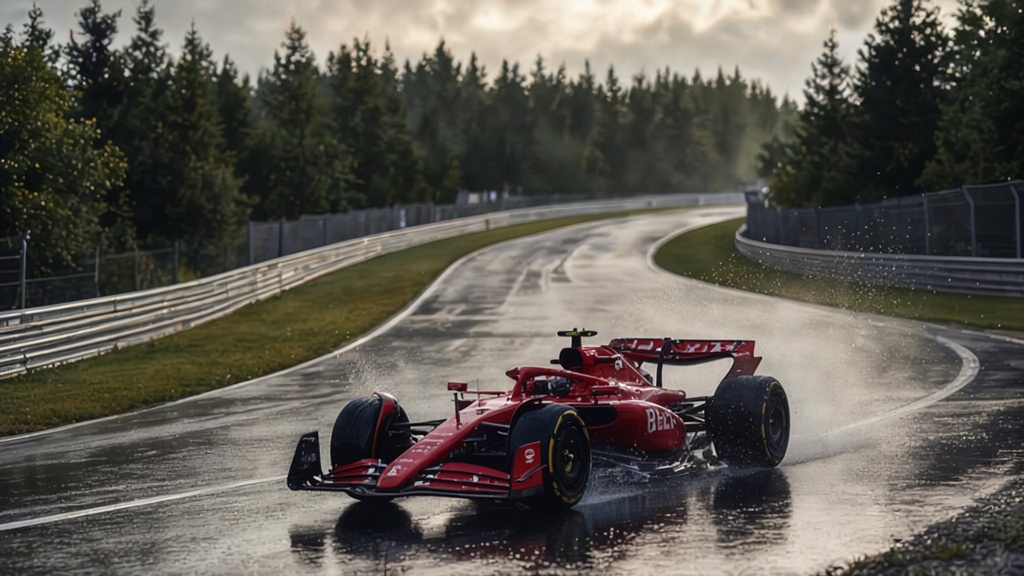

Chapter I: The Ultimate Test for the 2026 Regulations
The Circuit de Spa-Francorchamps has historically served as the ultimate barometer of a Formula 1 car’s design. Featuring massive elevation changes, high-speed sweeps, and long, power-dominated straights, the Belgian layout presents a unique set of challenges. Under the revolutionary 2026 technical regulations which introduced smaller, lighter chassis and advanced active aerodynamics Spa is expected to push both driver and machine closer to the edge than ever before.
The compression at the bottom of Eau Rouge and the subsequent climb through the blind crest of Raidillon will put unprecedented vertical loads on the highly complex 2026 underfloor tunnels. Furthermore, Spa’s second sector requires high downforce and mechanical compliance through corners like Bruxelles and the double-apex Pouhon, whereas Sectors 1 and 3 require maximum straight-line velocity. This stark contrast makes the execution of active aerodynamics absolutely critical. Any technical anomaly during the transition between the high-downforce Z-mode and the low-drag X-mode could result in catastrophic consequences at high speed, making the initial scrutineering and free practice reconnaissance crucial.
Chapter II: The Championship Battle: Mercedes’ Reign Challenged
Mercedes-AMG Petronas has enjoyed a dominant start to the 2026 campaign, currently leading the Constructors’ Championship with 333 points. However, the intra-team battle between rookie sensation Andrea Kimi Antonelli and the experienced George Russell has reached a boiling point. Antonelli, who sits atop the standings with 179 points, was seemingly unstoppable after taking five consecutive victories earlier in the season. Yet, the young Italian is facing his first major hurdle of the year.
A difficult weekend at Silverstone saw Antonelli qualify on pole position but finish a disappointing 15th after receiving a costly penalty, a decision Mercedes chose not to appeal. This opens the door for George Russell, who sits second in the championship with 154 points. Having taken victories in Melbourne and Spielberg, Russell is currently in peak form. Spa-Francorchamps will be a defining moment for the Brackley based squad; Antonelli needs to re-assert his authority, while Russell will seek to exploit his teammate’s recent struggles to close the 25-point gap.
Chapter III: Ferrari’s Momentum: Leclerc and Hamilton Eye the Summit
Scuderia Ferrari enters Spa-Francorchamps with wind in their sails, currently sitting second in the Constructors’ standings with 255 points. Charles Leclerc’s spectacular victory at Silverstone on July 5, 2026, marked his first triumph since his 2024 Monaco GP win. Leclerc executed a flawless race, overtaking Antonelli at the start and holding off a late-charge from Russell. This victory has elevated Leclerc to fourth in the championship with 108 points, injecting massive confidence into the Maranello camp.
Equally formidable is Lewis Hamilton, who sits third in the standings with 147 points. The seven-time world champion has adapted brilliantly to the SF-26, taking his first victory for the Scuderia at Barcelona in June. Speaking about his form and the team’s progress under Fred Vasseur, Hamilton remarked: “The first triumph is very close” highlighting that the lighter, more agile 2026 regulations have finally provided him with a stable platform. If Ferrari can manage their tire degradation in Belgium, their straight-line speed could make them favorites to challenge Mercedes for the victory.
Chapter IV: Red Bull’s Downward Spiral: Verstappen’s Mount of Troubles
For Red Bull Racing, the 2026 season has been nothing short of a nightmare. The Milton Keynes team has struggled significantly to adapt to the new power unit regulations, leaving them a distant fourth in the Constructors’ standings with just 128 points. Max Verstappen, the defending four-time world champion, is currently 7th in the standings with 76 points and has yet to register a single race victory this year.
Verstappen’s frustrations reached a boiling point at Silverstone, where he suffered a high-speed DNF after running out of road. Following the crash, a visibly irritated Verstappen stated: “It was very dangerous. At some point, you just have had enough.” The Red Bull chassis has struggled with balance transitions, and their power unit has shown a tendency to “derate” prematurely on long straightaways. With Spa featuring the long Kemmel Straight, Verstappen and his young teammate Isack Hadjar (8th with 52 points) face an uphill battle. If Red Bull cannot find a solution to their deployment issues, they risk being swallowed up by the midfield.
Chapter V: The Reigning Champion’s Dilemma: Norris and McLaren’s Search for Speed
Lando Norris entered the 2026 season with the prestigious number 1 on the nose of his McLaren, having secured his maiden Drivers’ Championship in a dramatic 2025 finale. However, his title defense has been quietly frustrating. Norris currently sits fifth in the standings with 97 points, while his teammate Oscar Piastri is sixth with 82 points. Despite McLaren occupying third in the Constructors’ Championship (179 points), the team has lacked the outright pace to fight Mercedes and Ferrari on a regular basis.
The MCL40 has shown excellent aerodynamic efficiency in high-speed corners, which should theoretically favor them through Spa’s second sector. However, their straight-line deficit remains a major vulnerability. In dirty air, the McLaren has struggled to maintain its pace, making overtaking difficult. To secure a podium finish this weekend, McLaren will have to rely on a clever fuel strategy and flawless execution during the pit stop phases, potentially using the undercut to jump their rivals.
Chapter VI: Technical Focus – Managing the 50/50 Power Unit Split at Spa
The technical talking point of the weekend revolves around energy management. The 2026 power units feature a radical 50/50 split between internal combustion engine (ICE) power and electrical energy. With the removal of the MGU-H, the MGU-K is the sole source of electrical recovery, harvesting kinetic energy strictly under braking.
This presents a massive logistical hurdle at Spa-Francorchamps. The track is highly power-sensitive but features very few heavy braking zones. Beyond La Source, Les Combes, and the Bus Stop chicane, there are limited opportunities to harvest energy. Consequently, drivers will have to carefully manage their state of charge (SoC). If a driver deploys their electrical energy too aggressively early on the Kemmel Straight, they will “clip” (run out of battery power) halfway up the hill, leaving them defenseless against rivals utilizing a slipstream or DRS. Managing this energy deployment while running in dirty air will be the key to defensive and offensive driving.
Chapter VII: Tire Degradation and Strategic Decisions
Pirelli, the control tire supplier for the WRC, has nominated its Scorpion KX gravel tires for the Estonian weekend, with the Soft compound serving as the primary choice and the Hard compound available as the option. Tire strategy in Estonia is a complex game of chess, heavily influenced by ambient temperatures, road cleaning, and the development of ruts.
During the first pass of the stages, the surface is covered in a layer of loose, sandy gravel. The soft compound is the preferred choice here, as its compliant tread block allows the tire to “dig” through the loose topsoil and find traction on the harder base beneath. However, this soft rubber is highly susceptible to wear and overheating if temperatures rise above 25°C, requiring drivers to manage their tire degradation through the longer stages.
For the second pass, the scenario changes completely. As the early cars sweep the road, the hard, rocky base is exposed, and deep ruts begin to form. The hard compound becomes highly valuable here, offering superior structural durability and resisting the sharp stones unearthed by the high-powered Rally1 machinery. If rain is introduced into the forecast, the challenge multiplies, turning the high-speed gravel tracks into a treacherous, muddy ice-skating rink where tire choice becomes a matter of survival.
Chapter VIII: Pirelli’s Tyre Selection and the Ardennes Weather Variable
For the high-energy demands of Spa, Pirelli has nominated the middle of their range: the C2 as the hard compound, the C3 as the medium compound, and the C4 as the soft compound. The asphalt at Spa is highly abrasive, and the immense lateral forces through corners like Pouhon put massive thermal stress on the tires. Consequently, managing tire degradation will be a major priority during each stint.
Strategic flexibility will be paramount. While an early pit stop can unlock a powerful undercut, it risks exposing the driver to extreme tire wear in the latter stages of the race. Additionally, the unpredictable Ardennes weather is expected to play its usual role. Friday and Saturday’s forecasts indicate a 60% chance of rain, meaning teams will likely run intermediate or wet tires during practice and qualifying. Navigating the damp tracks before cars enter parc fermé on Saturday afternoon will test the adaptability of every engineer on the pit wall.


