
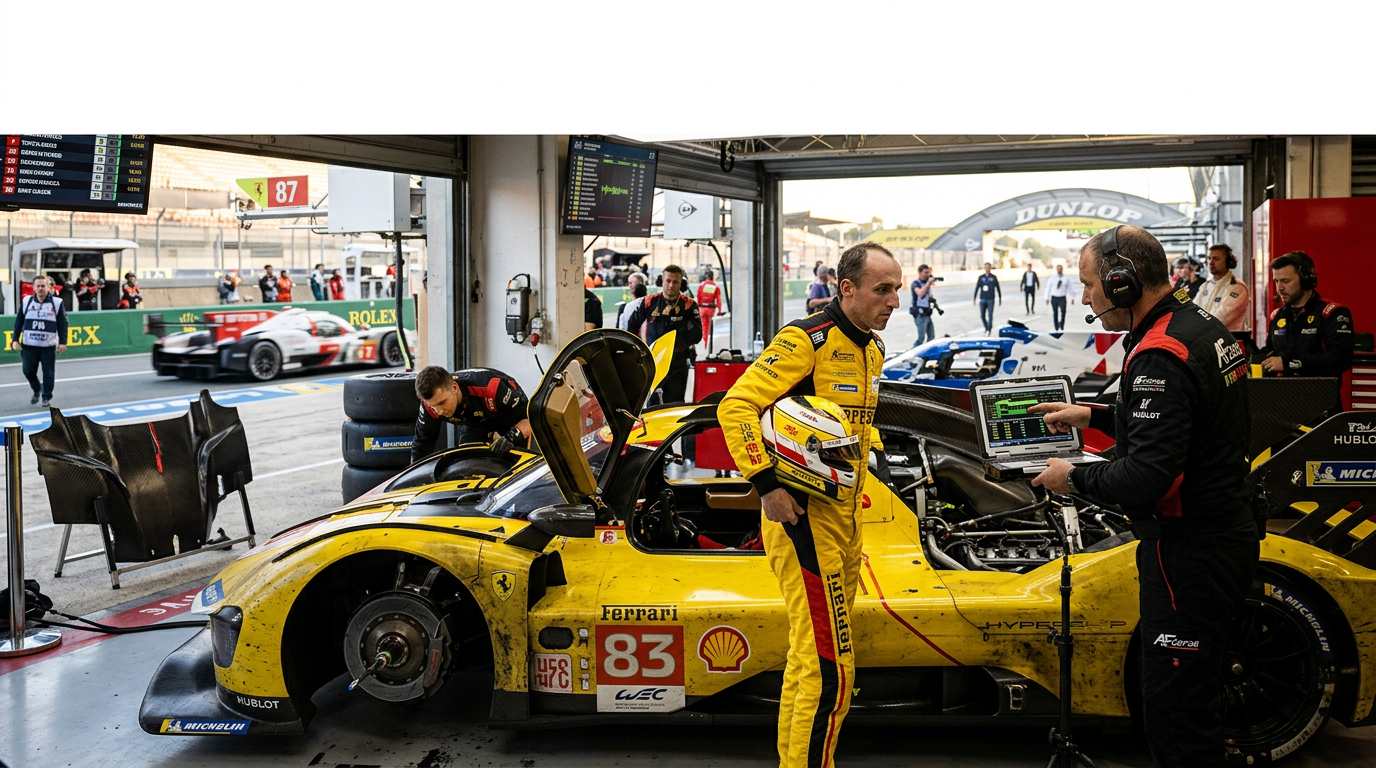

Chapter I: Defending the Legacy: The Privateer Ferrari 499P Threat
For Robert Kubica and his AF Corse teammates Yifei Ye and Phil Hanson, the 94th Le Mans was an opportunity to showcase the ultimate capabilities of a privateer entry. Campaigning the striking yellow-liveried #83 Ferrari 499P, the trio was a consistent threat to the factory programs. The car’s mechanical setup. featuring a highly progressive front double-wishbone suspension and a 2.9liter twin-turbo V6 coupled with a front-mounted electric motor, was optimized for the high-lateral loads of the Porsche Curves. Throughout the grueling night stints, Kubica demonstrated extraordinary pace, routinely matching the leading factory Toyota and BMW cars, and solidifying their position as genuine podium contenders.
Chapter II: The Critical Slow Zone Infraction and Penalty
However, the unforgiving nature of Le Mans regulations struck the #83 crew with brutal force on Sunday morning. During a local “Slow Zone” deployed near the Indianapolis corner to clear debris from a retired GT3 car, drivers were required to instantly limit their speed to exactly 80km/h using a steering wheel-mounted pit-limiter. Due to a minor telemetry calibration lag on the Ferrari steering wheel LED dashboard, Kubica initiated the speed limiter a fraction of a second too late, breaching the strict GPS-tracked speed boundary. The FIA stewards, operating under a zero-tolerance policy for safety violations, immediately issued a devastating penalty, costing the yellow Ferrari valuable track position and dropping them out of the lead lap.
Chapter III: Kubica’s Final-Hour Masterclass on Hard Compounds
Undeterred by the penalty, Kubica climbed back into the cockpit for a final, aggressive triple-stint on the hard Michelin compound. Operating in temperatures approaching 28C ambient, the Polish driver unleashed the true performance potential of the 499P. He managed the tire thermal cycling flawlessly, keeping the tire core temperature from spiking past 115C while sliding through the high-speed sweeping corners of the final sector. His metronomic lap times were the fastest on track during that phase, serving as a masterclass in tire preservation and recovery driving under intense psychological pressure.
Chapter IV: Software Mapping and Brake Thermal Dynamics on the 499P
To maintain such blistering pace while fighting a deteriorating brake balance, Kubica had to constantly adjust the car’s brake-by-wire (BBW) migration settings. As the carbon brake discs reached temperatures exceeding 950C into the heavy braking zones of the Mulsanne chicanes, the rear-axle regeneration of the energy recovery system had to be precisely synchronized with the hydraulic pressure on the front axle. A minor calculation error would lead to rear-axle locking, destabilizing the car at 320km/h . Kubica’s precise mechanical feedback allowed the engineers to update the engine braking maps in real-time, helping the team secure a hard-fought 7th place overall after Yifei Ye’s final splash-and-dash pit stop.


