
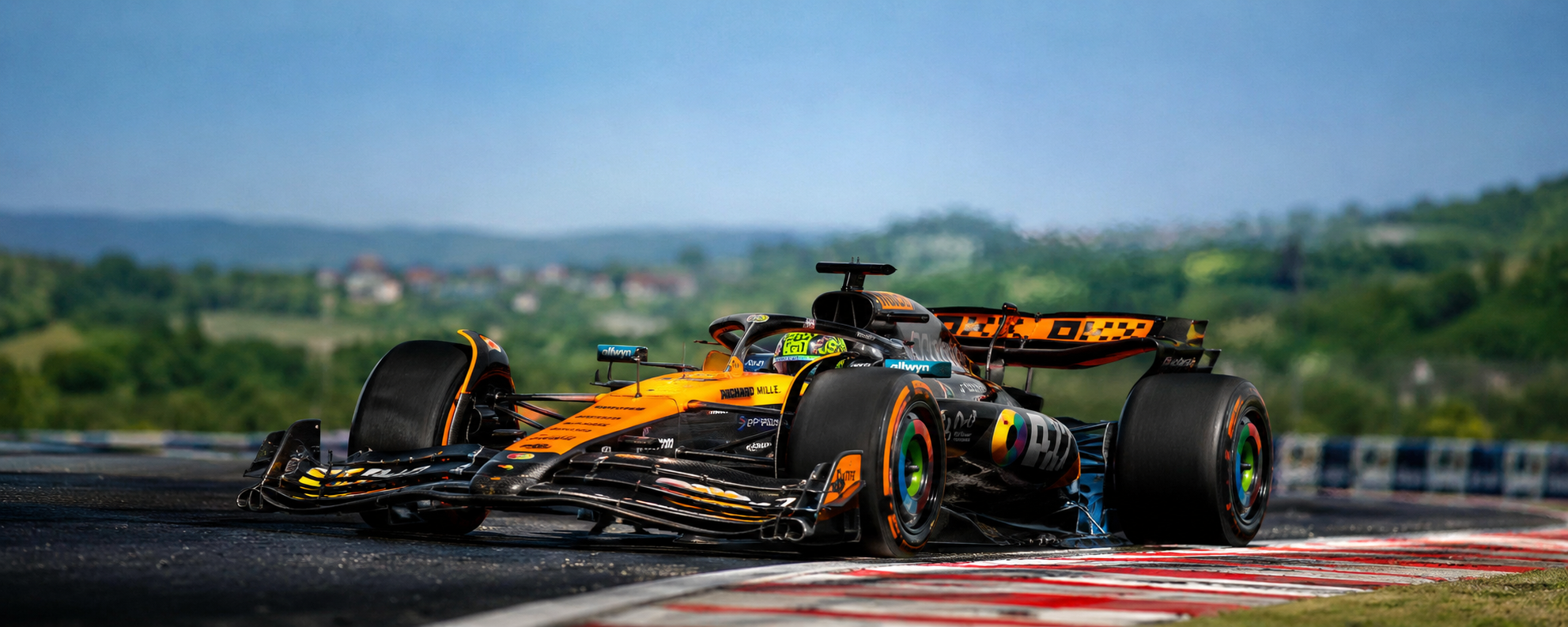

Hungaroring Crucible: Reigning Champion Answers the Call
The 2026 FIA Formula One World Championship arrived at the 4.381-kilometer Hungaroring for Round 13, presenting teams and drivers with one of the most physically and technically demanding layouts on the calendar. Known for its relentless sequence of 14 corners, minimal straight-line breathing room, and notoriously high track temperatures, the Hungarian circuit rewards high aerodynamic downforce, precise mechanical grip, and flawless thermal tire degradation management. Entering the weekend under mounting championship pressure, reigning World Champion Lando Norris delivered a masterclass in controlled aggression, capturing pole position on Saturday before translating his starting advantage into a historic first Grand Prix victory of the 2026 campaign.
The triumph was particularly significant for McLaren after a frustrating weekend at Spa-Francorchamps, where missed strategic opportunities cost the Woking-based outfit a potential victory. At the Hungaroring, however, the updated MCL40 showcased superior lateral chassis balance through the medium-speed twisting sectors, enabling Norris to maintain consistent lap times across extended stints. Despite losing the lead on the opening lap, Norris demonstrated tactical maturity by preserving his medium compound tires in dirty air, positioning himself to exploit clean air during the decisive middle phase of the Grand Prix.
Winning in Budapest provides McLaren with a crucial momentum shift as the 2026 season reaches its mid-point. For Norris, the victory ends a long winless stretch in 2026 and validates the extensive development program executed by McLaren’s technical division to optimize their power unit integration and active aerodynamic balance under the current technical regulations.
Saturday Drama: Qualifying Standings and Stewards’ Penalties
Saturday’s qualifying session produced high drama across all three sectors, setting the grid order and establishing early storylines that heavily influenced Sunday’s strategy. Norris executed a brilliant final flying lap in Q3 to secure pole position, edging out Ferrari’s Charles Leclerc and teammate Oscar Piastri. However, the post-qualifying narrative was dominated by two separate investigations conducted by the FIA stewards, both resulting in significant three-place grid penalties for key championship contenders.
Lewis Hamilton, who had originally qualified third in his Ferrari, was handed a three-place grid penalty for impeding Oscar Piastri in Sector 2 during the closing minutes of Q2. Telemetry and video evidence confirmed that Hamilton was running slowly on the racing line while preparing for his own timed attempt, forcing Piastri to take evasive action. Concurrently, Mercedes driver Kimi Antonelli received an identical three-place grid penalty for failing to slow sufficiently under yellow flags in Q1 following a minor off-track excursion for Cadillac’s Sergio Perez at Turn 4.
These post-qualifying stewards’ decisions dramatically reshaped the starting order for Sunday’s 70-lap race. Norris retained pole position, but Leclerc was elevated to the front row alongside him in second. Piastri moved up to third, while Max Verstappen who struggled with severe rear tire degradation throughout qualifying to finish sixth promoted to fourth on the revised grid. Hamilton was demoted to fifth, George Russell aligned in sixth, and Antonelli dropped to seventh, setting up a congested charge into Turn 1.
Lights Out: Piastri’s Bold Overtake and Early Race Dynamics
When the five red lights went out under sweltering Hungarian sunshine, Norris executed a clean launch off the line to cover the inside line into Turn 1. Behind him, Piastri got a superb start from the third grid slot, immediately challenging Leclerc around the outside of the opening hairpin. Harnessing superior traction on exit, Piastri tucked into Norris’ slipstream down the hill towards Turn 2.
Executing a textbook cut-back maneuver on the exit of Turn 2, Piastri swept past his teammate on the inside, taking the race lead in dramatic fashion. Further back in the pack, Hamilton made early progress by passing team mate Leclerc for fourth place before making wheel-to-wheel contact with Verstappen at Turn 3 as both drivers jostled for track position. Verstappen held his ground on the inside line, maintaining third place behind the leading McLaren tandem.
During the opening stint, Piastri maintained a narrow margin over Norris, managing a gap fluctuating between 1.2 and 1.8 seconds. While Norris reported over radio that he possessed greater raw race pace in clear air, McLaren pit wall opted to keep positions frozen, allowing both drivers to execute their target pit stop windows on the medium compound tires without incurring premature tire degradation from internal wheel-to-wheel combat.
The Turning Point: Traffic Collision and Piastri’s Agony
The complexion of the Grand Prix shifted fundamentally on Lap 39 during the second round of routine pit stops. Piastri was called into the pit lane first from the lead, switching to a fresh set of hard compound tires to cover off potential undercut threats from Verstappen and the chasing Ferrari pair. However, upon rejoining the track in Sector 1, Piastri immediately encountered backmarker traffic in the form of Carlos Sainz’s Williams.
Misjudging the closing speed into Turn 4, Piastri attempted an ambitious move down the inside of Sainz. Contact was made between Piastri’s front-wing endplate and Sainz’s left-rear tire, forcing both drivers wide off the apex. The incident cost Piastri over three seconds in lap time and left his front wing compromised with minor aerodynamic damage.
Capitalizing on Piastri’s delay, Norris unleashed a sequence of fastest personal sectors in clean air before diving into the pit lane at the end of Lap 41. McLaren’s pit crew executed a flawless 2.1-second wheel change, allowing Norris to rejoin comfortably ahead of Piastri to assume the net lead of the race. Piastri’s day deteriorated rapidly just three laps later when his car suffered a major mechanical failure in the gearbox, forcing the Australian to pull off the circuit near Turn 11 and retire from second position.
Technical & Strategic Warfare: Tyre Degradation and Power Unit Management
The high track temperatures exceeding 44°C placed extreme stress on the thermal construction of Pirelli’s medium and hard tire compounds. Throughout the 70-lap distance, rear tire degradation proved to be the primary limiting factor for team engineers. Red Bull faced persistent thermal degradation issues during the first stint, forcing Verstappen to modulate his throttle application out of slow-speed traction zones like Turn 1 and Turn 6/7 chicane to avoid blistering the tread surface.
Engineers were also forced to carefully monitor internal power unit temperatures and hybrid ERS deployment strategies. With the 2026 power unit regulations emphasizing increased electric energy deployment from the 300kW MGU-K system, managing state-of-charge levels through high-speed energy recovery zones was vital. Drivers who harvested efficiently under heavy braking into Turn 1 and Turn 12 were able to deploy full electrical boost down the main pit straight, creating defensive shields against DRS-assisted overtaking maneuvers.
Ferrari’s strategy team opted for an aggressive three-stop strategy for both Hamilton and Leclerc, aiming to utilize shorter stints on fresh soft and medium compounds to overcome their high tire wear rate. In contrast, McLaren, Red Bull, and Mercedes managed their degradation profiles effectively enough to execute two-stop strategies, which ultimately proved to be the superior tactical approach given the track track position track bias inherent to the Hungaroring.
Virtual Safety Car Chaos: Positions Swap and Podium Decoders
Piastri’s breakdown on Lap 44 prompted race control to deploy the Virtual Safety Car (VSC) to allow marshals to safely recover the disabled McLaren. The timing of the VSC triggered intense strategic activity inside the pit lane. Ferrari immediately called both Hamilton and Leclerc in for their third and final tire changes, taking advantage of the reduced pit stop time loss under VSC conditions.
Conversely, Max Verstappen and Mercedes rookie Kimi Antonelli, who had both completed their second planned stops shortly before the incident, elected to remain on track. This decision elevated Verstappen to second place and Antonelli to third. When the race resumed under green flag conditions, Hamilton emerged from the pit lane side-by-side with Antonelli at the exit line. Hamilton initially seized third position into Turn 1.
However, Mercedes telemetry and race control timing loops revealed that Antonelli had reached the designated VSC white line at the end of the start/finish straight fractionally ahead of the Ferrari. To avoid a guaranteed post-race penalty from the stewards, Ferrari instructed Hamilton to yield the position back to Antonelli on track. The young Italian driver defended brilliantly over the final 20 laps, absorbing intense pressure from Hamilton to secure a memorable third-place finish and his maiden Formula 1 podium.
Midfield Battles: Audi, Racing Bulls, and Aston Martin Upgrades
Behind the lead battle, the midfield provided intense wheel-to-wheel competition across all 70 laps. Racing Bulls enjoyed one of their strongest weekends of the 2026 season, capitalizing on an updated floor and sidepod aerodynamic revision introduced for Liam Lawson. Lawson executed a clean, precise strategy to finish in eighth place, earning vital championship points for the Faenza squad.
His teammate, rookie Arvid Lindblad, backed up the team’s strong form by finishing tenth to secure the final point, successfully repelling late-race attacks from Audi’s Gabriel Bortoleto in eleventh. Between the two Racing Bulls cars, Nico Hülkenberg delivered an exemplary drive for Audi, managing his hard compound tire degradation over a marathon 38-lap final stint to finish ninth, marking another points-scoring display for the German manufacturer.
Aston Martin brought significant floor and front wing aerodynamic revisions to Budapest for Lance Stroll and Fernando Alonso. While the updates yielded improved high-speed stability, both drivers were hampered by poor qualifying positions and could only finish 13th and 14th respectively, splitting the Alpine entries of Pierre Gasly and Franco Colapinto. Further back, Haas and Williams struggled with severe rear tire overheating, while Sergio Perez’s pit-lane starter drive in the Cadillac netted 18th position after late-race pit stops.
Championship Outlook: Summer Break Context and What Lies Ahead
Lando Norris’s victory at the Hungaroring dramatically reshapes the narrative of the 2026 Drivers’ World Championship as teams prepare for the traditional FIA summer shutdown. By securing maximum points along with the fastest lap bonus point, Norris significantly narrows the gap to the championship leader, proving that McLaren possesses the mechanical and aerodynamic baseline required to challenge for back-to-back world titles under the 2026 technical regulations.
For Red Bull Racing, Verstappen’s resilient drive to second place minimized the damage on a circuit where their RB22 chassis struggled for baseline balance. The Milton Keynes team leaves Hungary with clear technical areas to address, particularly regarding low-speed mechanical traction and thermal tire management ahead of fast, high-speed venues like Zandvoort and Monza.
With the 2026 calendar featuring tight competition across all ten teams and recent calendar confirmations such as the FIA and Formula 1 confirming Sepang in Malaysia as the host venue for the postponed Bahrain Grand Prix in October the second half of the season promises relentless competitive drama. As factories shut down for the mandatory two-week summer break, the title race remains wide open, with McLaren, Red Bull, Ferrari, and Mercedes all having proved their ability to win Grands Prix in this captivating 2026 season.


