
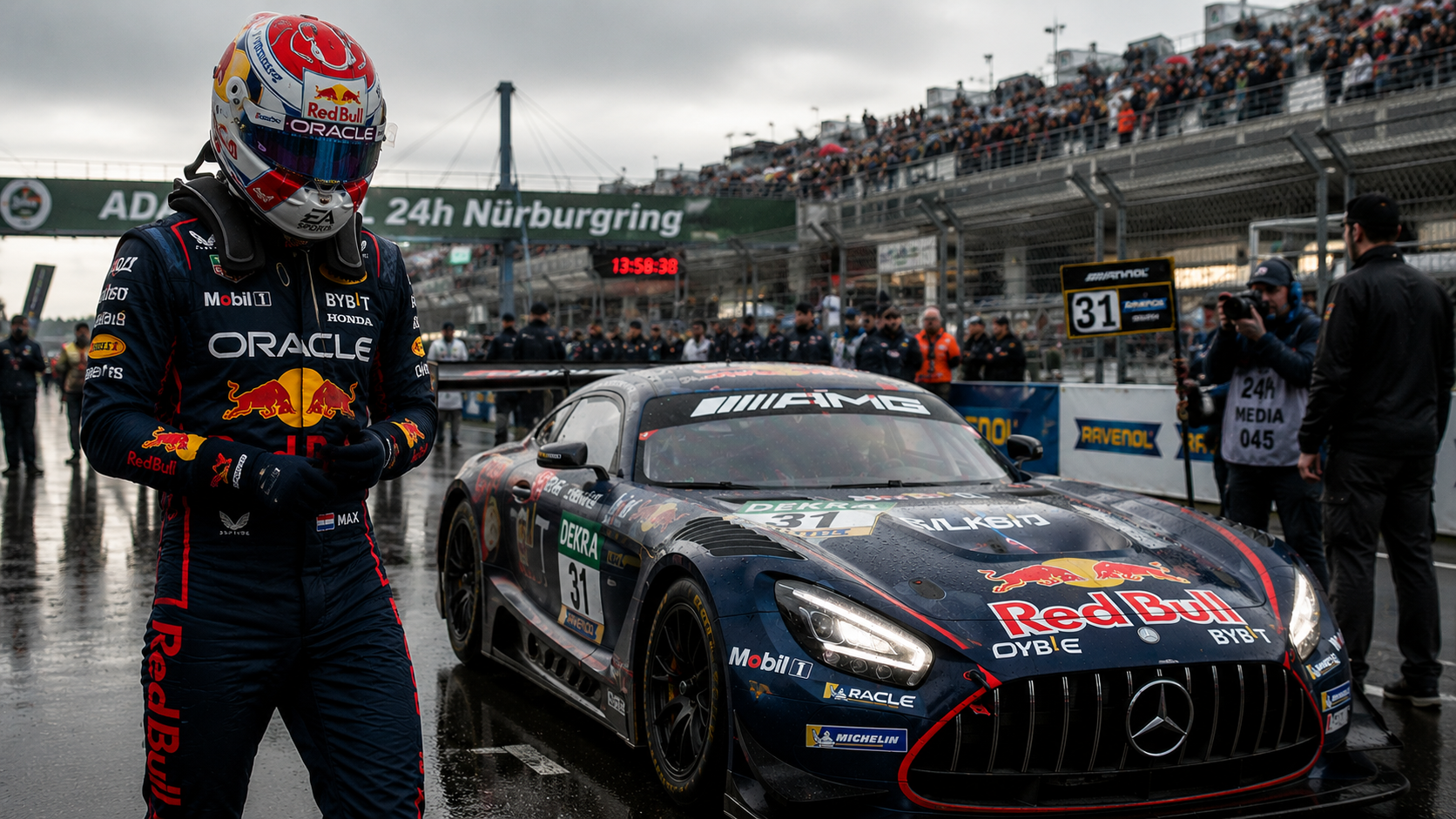

Chapter I: The Atmosphere, Paddock Rumors, and Local Lore
The Nürburgring Nordschleife does not bow to reputation. For nearly a century, this 25.3-kilometer labyrinth carved through the Eifel mountains has chewed up and spat out motorsport royalty. Yet, when the paddock gates opened for the 2026 edition of the ADAC RAVENOL 24h Nürburgring, the historic venue was hit by a shockwave unlike anything seen in modern endurance racing. The catalyst? Max Verstappen.
Stepping away from his familiar single-seater domain, the reigning Formula 1 icon stunned the global motorsport community by anchoring a top-tier Mercedes-AMG GT3 entry. The “Verstappen Effect” was immediate and overwhelming. Event organizers reported an unprecedented, instantaneous ticket sell-out, with over 240,000 fanatical spectators packing the campsites from Hatzenbach to Schwalbenschwanz.
In the weeks leading up to the event, the paddock hummed with fierce political and technical gossip. Could an F1 driver, used to millimeter-perfect asphalt, infinite runoff zones, and highly sophisticated aerodynamic downforce, genuinely adapt to the violent, high-kerb, multi-class chaos of the Nordschleife? Skeptics among the endurance establishment whispered that the sheer media circus surrounding the Dutchman would disrupt his team’s focus. The pressure on Verstappen was immense, not only did he have to master the ultra-competitive SP9 class, but he also had to do so under the microscopic lens of a frenzied global media core that had descended upon the Eifel region.
Christian Horner (ex-Red Bull Racing Team Principal) speaking to reporters in the Monaco F1 paddock on the Thursday before the event:
Max lives and breathes racing; if he isn’t in our car, he’s on his simulator or seeking out the next ultimate challenge. The Nürburgring 24 Hours is a brutal race, and while some might see the Mercedes-AMG connection as unusual given our F1 rivalry, we fully support his passion. It’s magnificent for motorsport as a whole.
Chapter II: The Quirks of the Terrain and Competitor Dilemmas
The Nordschleife represents a completely different philosophical challenge compared to modern Grand Prix circuits. To be fast here in a GT3 machinery requires a delicate compromise between stiff, aerodynamic efficiency for the ultra-fast Döttinger Höhe straight and a compliant, forgiving suspension setup to handle the violent compressions at Fuchsröhre and the airborne crests of Pflanzgarten.
For Verstappen, the primary obstacle was the behavior of the Mercedes-AMG GT3 compared to his everyday machinery. GT3 cars rely heavily on mechanical grip, utilizing ABS and traction control systems that are entirely absent in Formula 1. Furthermore, the Eifel weather provided its trademark hostility—patchy dampness, varying track surfaces, and severe tire degradation over multi-lap stints.
Verstappen’s driving style, usually characterized by ultra-late braking and sharp, aggressive corner entries, had to be radically adapted. On the bumpy, unforgiving Nordschleife tarmac, an overly aggressive turn-in can cause severe understeer or provoke a terminal snap of oversteer on the high kerbs. The dilemma was clear: should the engineers set up the AMG to be hyper-reactive to match Max’s razor-sharp reflexes, or opt for a safe, stable endurance setup that his co-drivers could comfortably pilot over a grueling 24-hour distance?
Max Verstappen (Mercedes-AMG Driver) speaking to the host broadcaster during the official pre-race press conference in the Nürburgring Media Center:
You cannot treat the Nordschleife like a modern track. If you attack the apexes at Adenauer Forst or Brünnchen with the same mindset as a Spielberg or Austin, the barrier will catch you out. The car needs to move, it needs to breathe with the bumps. Managing the traffic with slower VT2 or Cup 3 cars while keeping the tires alive across a triple-stint is where this race is won or lost.
Chapter III: The Chronological Narrative with Event Color
As the green flag waved under a moody, overcast Eifel sky, the media spotlight burned brightest on the front rows of the SP9 grid. From the opening stints, the pace was relentless. Top-tier machinery from Porsche, BMW, and Audi traded fast laps, but all eyes remained fixed on the timing screens tracking the Mercedes-AMG GT3.
When Verstappen climbed into the cockpit for his first competitive stint during the tricky twilight hours, the atmosphere in the grandstands reached a fever pitch. He was immediately thrown into the deep end, battling severe tire degradation on a cooling track. Rather than showing caution, Verstappen put on a technical masterclass. His F1-honed spatial awareness allowed him to slice through heavy multi-class traffic with breathtaking precision, capitalizing on the high mechanical grip of his AMG.
Drama struck around midnight. A sudden downpour hit the Hohe Acht section of the circuit while the Grand Prix track remained completely dry. As rival GT3 cars spun into the barriers or suffered costly punctures, Verstappen’s car-control shone. Navigating the treacherous “black ice” sensation of greasy tarmac on slick tires, he guided the car safely into the pit lane for a crucial switch to wet-weather compounds, executing a tactical masterstroke that vaulted his crew right into podium contention.
Maro Engel (Mercedes-AMG Performance Driver & Co-driver) speaking to journalists in the pit lane during the early morning hours:
What Max is doing out there is mind-blowing. To jump into a GT3 car, in these conditions, and immediately match the pace of the Nordschleife specialists who spend their entire lives here… it’s unreal. His feedback on the tire degradation and the dampers at the compression points has been incredibly precise.
As the grueling hours ticked down toward Sunday afternoon, mechanical endurance became the ultimate arbiter. While several leading entries succumbed to technical failures and suspension damage from the brutal track surface, Verstappen’s car ran like clockwork. During the final, high-stakes stints, Max locked into a ferocious battle for the podium positions, pushing his machinery to the absolute limit while managing understeer caused by a slightly worn front splitter.
When the checkered flag finally waved, cementing a monumental podium finish for the Mercedes-AMG squad, the grandstands erupted. The historic weekend proved beyond doubt that the “Verstappen Effect” wasn’t merely a marketing phenomenon, it was a triumph of pure, unadulterated racing pedigree on the world’s most dangerous race track.


