

Chapter I: Russell’s Masterclass from Pole Position
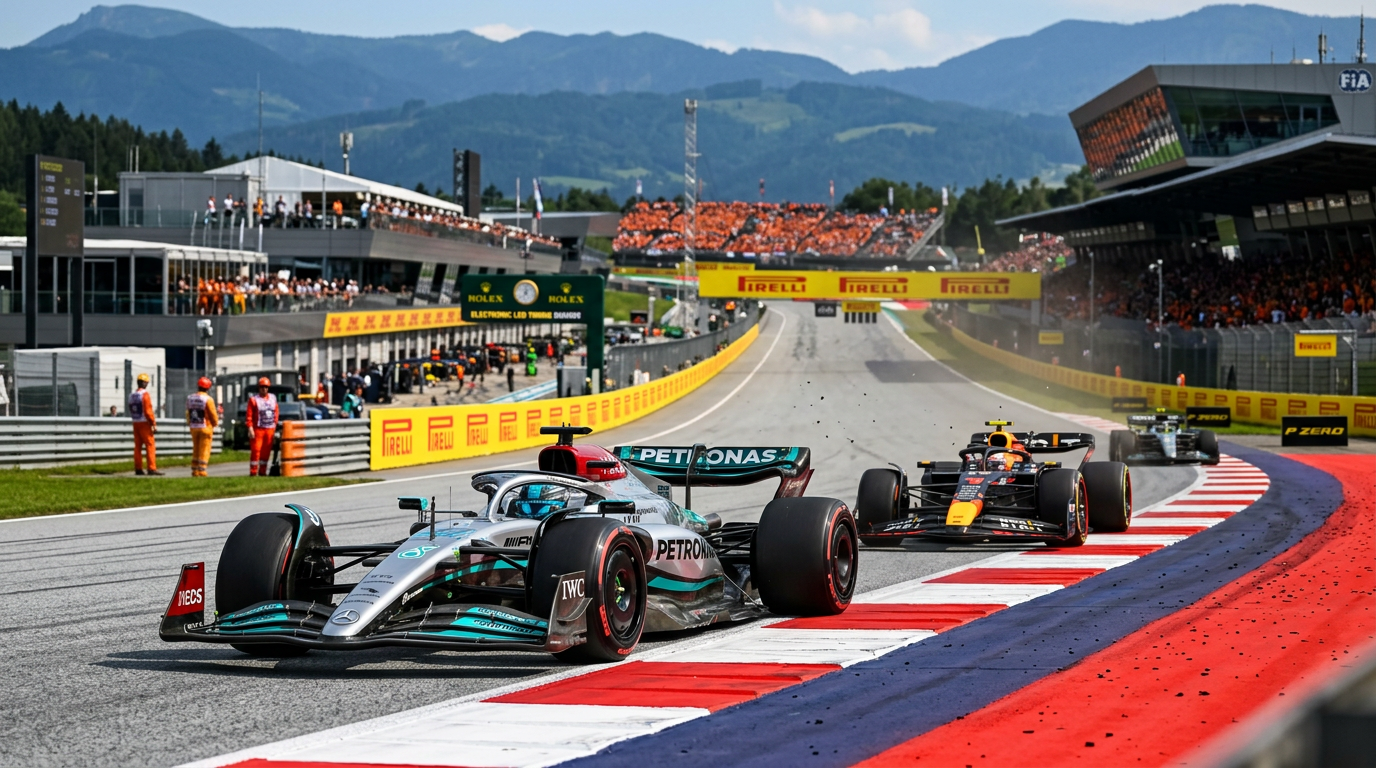
The final Sunday of the 2026 Formula 1 Austrian Grand Prix belonged to George Russell, but the British driver had to sweat for every single millisecond of his seventh career victory. Starting from pole position after a brilliant qualifying lap of 1:06.113, Russell positioned his Mercedes W17 Hybrid perfectly on the inside of Turn 1 at the start, successfully breaking the slipstream for the chasing pack behind. Throughout the opening 25 lap stint on the Medium C4 compound, Russell demonstrated impeccable tyre management. He maintained a stable 3.2s gap to the Ferrari of Lewis Hamilton, utilizing Mercedes’ superior front-end bite in the high-speed Sweeper at Turn 7 and the downhill plunging Turn 8. His smooth steering inputs kept the front-left tyre surface temperatures stabilized at an optimal 115C, completely mitigating the graining issues that began to plague his closest rivals.
Chapter II: Verstappen’s Resilient Charge from Q3 Setback
The primary threat to Mercedes’ dominance did not come from the front row, but from the third row of the grid. Max Verstappen, seeking redemption after a costly crash in Turn 10 during Saturday’s Q3 session, started the Grand Prix from a disappointing 5th position. However, the Red Bull Racing driver showcased why he is a four-time World Champion. When the lights went out, Verstappen immediately went on the offensive, passing Lando Norris into Turn 3 on the opening lap. Deploying Red Bull’s highly efficient 2026 power unit, which features a highly advanced thermal energy recovery system yielding up to 350kW of electrical deployment, Verstappen closed down the Ferrari of Lewis Hamilton. After an intense multi-lap battle, Verstappen secured P2 on Lap 11 and set his sights on the leading Mercedes, initiating a relentless, high-speed chase.
Chapter III: Antonelli’s Championship Damage Limitation
While Russell and Verstappen engaged in their high-stakes duel at the front, championship leader Andrea Kimi Antonelli was fighting a war of attrition of his own. The young Italian, who had shown incredible pace during Friday’s long-run simulations, found himself compromised by qualifying confusion and on-track errors. Despite these setbacks, Antonelli drove with ferocious determination. He managed to extract maximum performance from his Mercedes chassis on the Hard C3 tyre compound, recovering from several early-race track limit scares to close down the leaders. His final stint was a masterclass in aggressive tire thermal cycling, allowing him to systematically hunt down and pass Oscar Piastri and Lewis Hamilton.
Chapter IV: Thermal Management and Tyre Degradation on Spielberg Tarmac
Under a scorching Styrian sun, with ground temperatures peaking at a punishing 50C, managing tyre degradation was the defining engineering challenge of the race. The abrasive asphalt of the Red Bull Ring, combined with the extreme traction demands out of Turn 1 and Turn 3, put immense thermal strain on the rear Pirelli rubber. Teams were forced to adjust their traction control mappings to limit wheelspin, as even a minor slide could overheat the tyre core and lead to catastrophic blistering. Mercedes’ suspension kinematics, specifically their progressive rear anti-squat geometry, proved to be the class of the field. This engineering advantage allowed Russell and Antonelli to run slightly lower tyre pressures (14.5 ps rear), maximizing the contact patch and distributing the thermal load more evenly than the stiffer Red Bull RB22, which struggled with rear-end sliding in the final sector.


