

Chapter I: The Post-Event Steward Inquest and Digital Surveillance
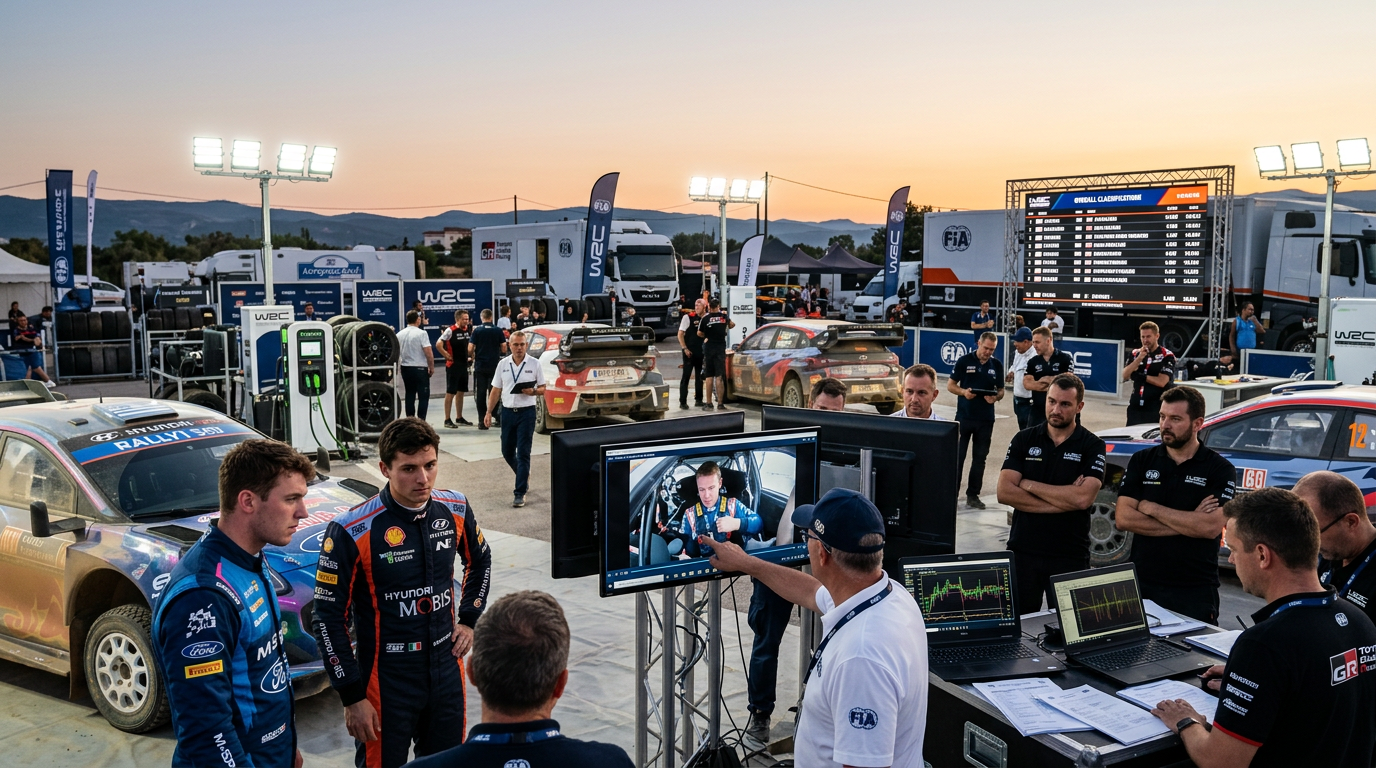
The festive atmosphere of the podium ceremony in Lamia had barely subsided when tension gripped the service park late Sunday evening. What appeared to be the final classification was suddenly thrown into question as the FIA Stewards initiated an exhaustive post-race inquest. Utilizing high-definition onboard footage streamed in real-time to race control via the mandatory FIA Safety Cameras, as well as digital telemetry logs, officials began reviewing team procedures following mid-stage stoppages. The investigation quickly zeroed in on two crews: M-Sport Ford’s Josh McErlean and Hyundai Shell Mobis’ Adrien Fourmaux. The subsequent hearings, which dragged late into the Greek night, concluded with the issuance of devastating 1 minutes.
time penalties to both drivers, sending shockwaves through the paddock and completely reshaping the rally’s top six.
Chapter II: The Infractions Explained: Mechanics of the Safety Harness Protocols
The infractions targeted a fundamental and non-negotiable tenet of motorsport safety: the secure fastening of safety harnesses while the vehicle is in motion on a live stage. According to Appendix L, Chapter III, Article 1 of the FIA International Sporting Code, all occupants must be fully and correctly restrained by their safety belts at all times when a vehicle is moving.
During SS12, McErlean’s co-driver, Eoin Treacy, unbuckled to assist with a minor mechanical recovery on-stage. In the frantic rush to restart, the car pulled away and traveled several hundred meters while Treacy was still actively threading and locking the six-point Sabelt harness. A nearly identical scenario unfolded on SS16 with Fourmaux’s co-driver, Alexandre Coria, after a brief halt. Telemetry confirmed that both cars reached significant speed before the harnesses were fully engaged. Despite team arguments emphasizing the extreme pressure of the situation and the brief duration of the violations, the stewards remained uncompromising. They reiterated that safety protocols cannot be compromised for competitive gain, establishing a strict precedent for the zero-tolerance era of modern rallying.
Chapter III: Championship Repercussions: The Toyota Windfall
The sporting impact of these 1 minutes penalties was immediate and severe, particularly for M-Sport Ford. Josh McErlean, who had been celebrating a hard-earned, career-best 4th place finish in Greece, was demoted to 6th in the final classification, his dreams of a breakthrough result dashed by a technical oversight. Adrien Fourmaux was similarly relegated, dropping from 6th to 7th.
The undisputed beneficiary of this administrative shake-up was Toyota Gazoo Racing. Sami Pajari was promoted to a stellar 4th overall, while championship leader Elfyn Evans was elevated from7th to 5th place. For Evans, this was an invaluable stroke of luck; after a grueling Friday spent “road-sweeping” the thick layer of loose Greek dust, which cost him minutes in the overall standings, the Welshman walked away with a significantly larger points haul than his weekend’s raw pace seemed to promise. Under the complex WRC points structure, this promotion allowed Evans to expand his championship lead over teammate Takamoto Katsuta to 11 points, and maintain a crucial 37 point buffer over the fast-closing Sébastien Ogier.
Chapter IV: The Strategic Fallout and the Zero-Tolerance Era
This ruling serves as a stark reminder of the immense physical and operational demands placed not just on WRC drivers, but on their co-drivers as well. In the high-stress environment of a Rally1 cockpit, where split-second decisions dictate victory or disaster, administrative precision is as vital as mechanical reliability. With the hybrid machines producing massive kinetic energy and utilizing high-voltage 750V electrical systems, the margins for error are nonexistent.
Following the decisions, team managers from both M-Sport and Hyundai immediately implemented revised cabin checklist protocols. Co-drivers will now be strictly required to verbally confirm “harness locked” over the intercom before the driver is permitted to engage first gear and release the handbrake. While the penalties were a bitter pill to swallow for McErlean and Fourmaux, the FIA’s uncompromising stance highlights their commitment to ensuring that even in the heat of a championship battle, human safety remains paramount.


