
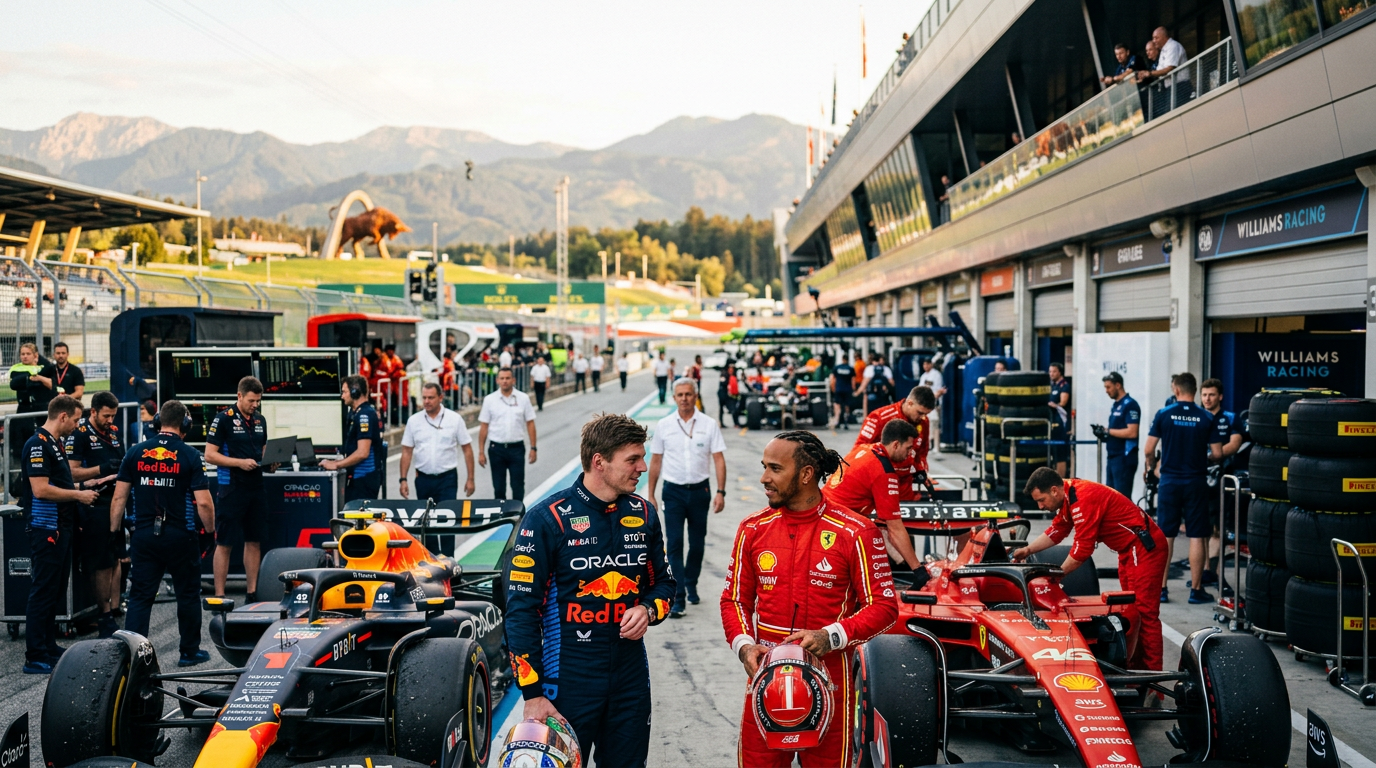

Chapter I: Spielberg’s High-Stress Braking Dynamics
The Red Bull Ring’s layout represents a unique engineering paradox: a short, 4.318km lap featuring three massive straight-line DRS zones punctuated by severe, heavy-braking corners. This profile subjects the braking systems to extreme thermal loading, with front carbon brake disc temperatures exceeding 1000C in the braking zones of Turn 1, Turn 3, and Turn 4. In the 2026 hybrid era, braking is further complicated by the interaction between the physical hydraulic brakes and the massive MGU-K electrical harvesting system. If the transition between friction braking and kinetic energy recovery is not perfectly mapped, the car suffers from rear-axle instability, leading to lock-ups and lost lap time.
Chapter II: The Ferrari-Red Bull Wheel-to-Wheel Showdown
This high-speed braking environment set the stage for a spectacular wheel-to-wheel battle between Max Verstappen and Lewis Hamilton during the opening phase of the race. On Laps 8-11, the two rivals engaged in a breathtaking display of racecraft. Utilizing the slipstream up the steep incline to Turn 3, Verstappen repeatedly launched audacious lunges down the inside of Hamilton’s Ferrari SF-26. Hamilton, drawing on his immense experience, used the wider track on the exit of Turn 3, to generate better traction, pulling side-by-side with the Red Bull down the short chute to Turn 4. The two former title rivals ran millimetres apart through the sweeping right-hander, trading positions multiple times before Verstappen finally secured P2 with a late-braking maneuver on Lap 11, delighting the passionate crowd.
Chapter III: Williams’ Electrical Disintegration and Sainz’s DNF
The dynamic flow of the Grand Prix was interrupted on Lap 24 by a sudden and highly disappointing technical failure for Williams. Carlos Sainz, who had qualified an impressive 17th but was executing a brilliant recovery drive into the point-scoring positions, suddenly lost all drive along the main straight. The Williams FW48 suffered a catastrophic failure of its Energy Storage (ES) unit, causing a complete electrical shutdown. Sainz was forced to park his car adjacent to the pit wall, bringing a premature end to his competitive run and triggering the Virtual Safety Car. This technical failure highlighted Williams’ ongoing struggles with high-voltage reliability under the demanding new 2026 electrical regulations, leaving the team with significant homework ahead of the upcoming British Grand Prix.
Chapter IV: McLaren’s Aerodynamic Puzzle and the Road Ahead
For McLaren, the Austrian Grand Prix proved to be a weekend of missed opportunities and aerodynamic confusion. While Oscar Piastri drove a clean and calculated race to secure a solid 4th place, Lando Norris struggled to find consistent balance in his car, finishing a lonely 7th. McLaren’s engineering team struggled to optimize their high-downforce aerodynamic package for the unique high-altitude conditions of the Red Bull Ring 677 meters above sea level), where the thinner air reduces overall downforce and cooling efficiency. The team was forced to run larger cooling louvers, which increased drag and left Norris vulnerable on Spielberg’s long straights, emphasizing that McLaren still has technical hurdles to clear if they are to consistently challenge Mercedes and Red Bull for the championship.


