
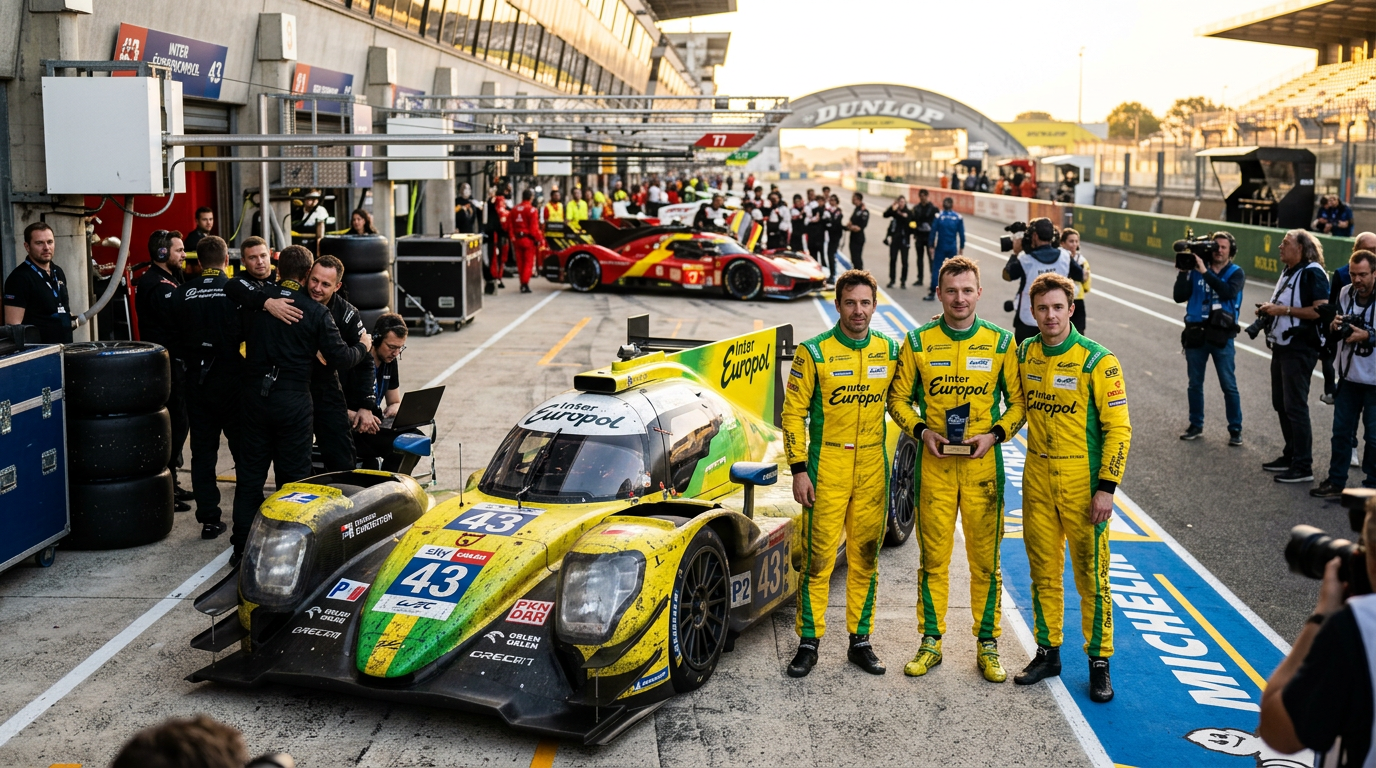

Chapter I: A Distinct Visual Identity with Elite Engineering Underpinnings
Inter Europol Competition entered the 2026 edition of the 24 Hours of Le Mans with a striking visual tribute to their heritage. The #43 Oreca 07-Gibson debuted an artistic “Art Car” livery, inspired by the vibrant yellow and green impressionist landscapes of Polish rapeseed fields. However, underneath this unique aesthetic lay a highly optimized racing machine. Starting from fourth on the grid, Bronze-rated driver and team cornerstone Jakub Śmiechowski executed a flawless opening segment. By utilizing conservative engine mappings on the 4.2-liter naturally aspirated Gibson V8 and avoiding the heavy, carbon-shattering curbs of the Dunlop Chicane during his initial stints, Śmiechowski preserved the structural integrity of the front splitter and floor. This early discipline ensured the car maintained its peak aerodynamic downforce profile for the faster professional drivers to exploit later.
Chapter II: Strategic Positioning and Hybrid-Era Traffic Navigation
Navigating the massive speed differentials between the Hypercars and the LMP2 machinery at Le Mans requires immense spatial awareness, especially with 18 top-tier prototypes fighting for overall glory. Śmiechowski’s role was to stabilize the gap to the leading Panis and Duqueine entries while managing the aerodynamic wake of passing Hypercars. The underbody diffuser of the Oreca 07 is highly sensitive to pitch and roll variations caused by the turbulent air of passing LMDh and LMH cars. By adjusting his turn-in points at the high-speed Porsche Curves to stay out of the dirtier air channels, Śmiechowski minimized lateral tyre slip, laying the groundwork for a strategic assault as night began to blanket the French countryside.
Chapter III: Mastering the Goodyear Control Compound in Cool Temperatures
As midnight approached, track temperatures at the Circuit de la Sarthe plummeted to just 14C, presenting a critical engineering challenge. The LMP2 class operates under a single control dry compound supplied by Goodyear, which requires a highly specific thermal window of 85-105C to function at peak efficiency. If the tyre carcass cools down too much on the 6km Mulsanne Straight, the tread surface undergoes “cold graining,” destroying the grip level and forcing premature pit stops. While rival squads struggled with tyre pressure stabilization, Inter Europol’s engineering wall, led by seasoned race strategists, introduced a highly progressive initial pressure strategy.
Chapter IV: Executing Fatal Triple-Stints Under the Cover of Darkness
This mechanical adjustment allowed Tom Dillmann and Nick Yelloly to execute devastating triple-stints on a single set of Goodyear rubber during the coldest hours of the night. Yelloly, drawing on his extensive development experience, managed the tyre lateral loads perfectly through the sweepers, keeping the carcass temperature stabilized at an optimal 92 Ceven under local Slow Zone conditions. By eliminating two complete tyre changes over a crucial six-hour window, Inter Europol saved roughly 50s in pit lane delta time. This calculated risk propelled the yellow-and-green #43 prototype into a commanding, one-lap lead over the #29 Forestier Racing by Panis entry, while also allowing the sister #343 car to climb into podium contention.


