
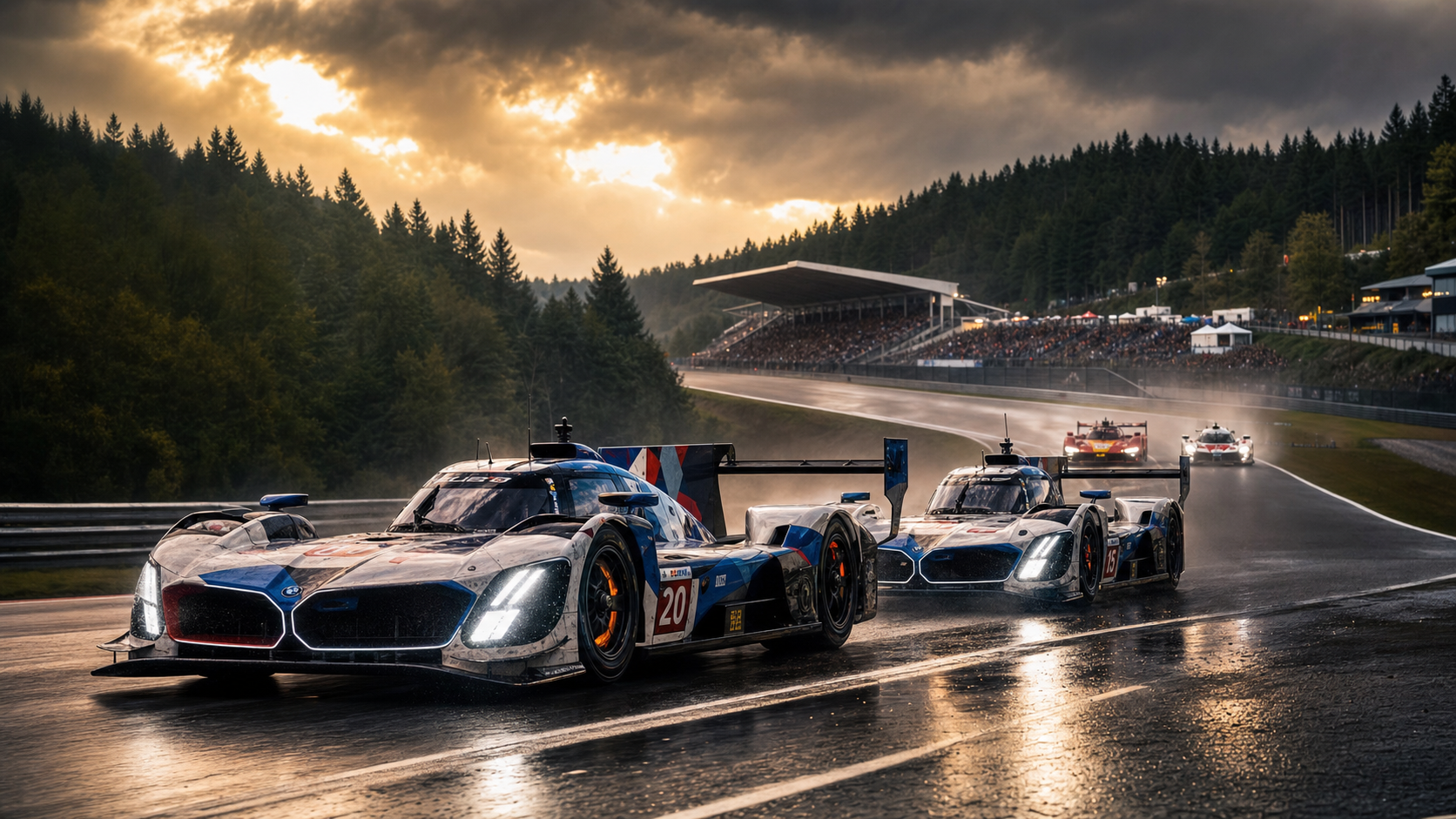

Chapter I: The Atmosphere, Paddock Rumors, and Ardennes Magic
The TotalEnergies 6 Hours of Spa-Francorchamps has always been more than just a dress rehearsal for the 24 Hours of Le Mans; it is a brutal, unforgiving crucible where reputations are forged or thoroughly shattered. In May 2026, the legendary circuit nestled deep in the Ardennes forest welcomed a record-breaking crowd of over 101,000 passionate endurance racing fans. The atmosphere was electric, heavy with the scent of high-octane fuel, local frites, and the tangible tension of a Hypercar grid that had grown into the most competitive top-flight sports car category in a generation.
Going into the weekend, the paddock rumors were centered squarely on the operational pressure suffocating BMW M Team WRT. Despite massive resources and a stellar driver lineup, the Bavarian giant had spent the early part of the 2026 FIA WEC season in the shadows of Ferrari’s relentless pace and Toyota’s bulletproof execution. For Vincent Vosse’s WRT squad, Spa was effectively home soil. The Belgian outfit, based just an hour away in Baudour, knew that local expectations were astronomical. Yet, Friday evening in the paddock painted a grim picture. A challenging, damp qualifying session saw the #20 and #15 BMW M Hybrid V8s stranded down in tenth and eleventh on the grid, seemingly lacking the single-lap tire-activation capabilities of their rivals.
Andreas Roos (Head of BMW M Motorsport) speaking to reporters in the WRT hospitality unit on Friday evening:
To say we are satisfied with row five and six would be a lie. The car has the foundational pace, but extracting that peak grip window in the changeable Ardennes conditions baffled us today. However, endurance racing isn’t won on Friday. We have a robust race car, our long-run tire degradation metrics look highly competitive, and the weather here always offers an operational opening. Tomorrow is a long, tactical game.
Chapter II: The Quirks of the Terrain and Competitor Dilemmas
The 7.004-kilometer Circuit de Spa-Francorchamps demands everything from a Hypercar’s aerodynamic and mechanical architecture. It is a track of extreme contrasts: the flat-out, high-compression terrors of Eau Rouge and Raidillon, the ultra-high-speed sweeps of Pouhon, and the low-speed, traction-critical hairpins of La Source and the Bus Stop chicane. For the engineers, setting up the complex LMDh-spec BMW M Hybrid V8 required a delicate compromise.
The primary adversary during the 2026 edition was a rapidly fluctuating track temperature. Under the bright Belgian sun, the tarmac temperatures spiked, drastically accelerating rear-tire thermal degradation. Teams faced a monumental dilemma: run a lower-downforce aero configuration to scream down the Kemmel Straight and risk shredding the Michelin slick tires through the twisty Sector 2, or crank up the wing, suffer down the straights, and lean heavily on mechanical grip.
BMW’s technical department took a calculated gamble. While Toyota opted for a high-downforce setup that ultimately overworked their rear rubber, and Ferrari ran ultra-trim aero profiles, BMW dialed in a refined suspension geometry designed specifically to stabilize the car’s dynamic camber under heavy load. By pairing this with highly optimized, bespoke hybrid deployment maps developed alongside Bosch, the M Hybrid V8 minimized understeer through Pouhon without destroying its tires. This engineering masterclass gave drivers like René Rast and Kevin Magnussen a compliant, predictable weapon over extended stints, turning a grid disadvantage into a long-run tactical masterpiece.
Chapter III: The Strategic Gambit and the Italian Stumble
When the green flag dropped, the race initially conformed to the expected script. The pole-sitting Ferrari 499P jumped out to a commanding lead, closely shadowed by the relentless Toyota GR010 Hybrids. Down in the midfield chaos, the BMWs played a patient waiting game. René Rast in the #20 Shell-liveried machine and Kevin Magnussen in the sister #15 car focused entirely on tire preservation, opting not to cook their rubber in the turbulent wake of mid-pack traffic.
The turning point arrived just before the two-hour mark. A dramatic Full Course Yellow (FCY), triggered by an LMGT3 spin at Stavelot, threw the pit lanes into a frenzy. While the leading Ferrari team hesitated, opting to leave their cars out for an extra lap to assess the neutralization duration, WRT sporting director pit-wall savants pulled the trigger instantly. Both BMWs dived into the pit lane.
It was a operational masterclass. The WRT mechanics executed flawless fuel and tire service under the FCY regime, effectively gaining over 25 seconds on the field. When the race went green, Ferrari attempted to claw back the lost time, but their charge was catastrophically blunted during the subsequent routine pit stop phase. An agonizing wheel-nut cross-threading error in the Ferrari pit lane cost the Prancing Horse precious minutes, dropping them out of true contention.
Vincent Vosse (BMW M Team WRT Team Principal) speaking on the official FIA WEC pit-lane feed during the fourth hour:
When the FCY was called, we didn’t hesitate. We knew our tire wear was low enough that we could double-stint the left sides and save massive time in the pits. The drivers executed the fuel-saving targets perfectly in the first stint to give us this strategic window. Now, it is all about managing the gap and watching the track limits.
Chapter IV: Flying in Clean Air to a Historic 1-2
The green flag waved at 13:00 local time, unleashing a pack of 17 Hypercars into the tight hairpin of La Source. Malthe Jakobsen executed a flawless start in the pole-sWith Ferrari delayed and the Toyotas visibly struggling with localized rear-tire thermal degradation, their drivers fighting massive power-down oversteer out of the slow corners, the BMWs found themselves in a dream scenario: leading the race in clean aerodynamic air.
The final two hours became an internal WRT showcase of relentless rhythm. In the #20 car, Robin Frijns delivered an astonishing triple-stint, utilizing the car’s optimized hybrid deployment to smoothly dispatch traffic without exposing the car to risk. Sheldon van der Linde then took over for the anchoring stint, putting on a clinic in high-speed precision. Behind them, the #15 car, now driven with fierce intensity by Dries Vanthoor alongside Raffaele Marciello, acted as the perfect rear guard, matching the sister car’s lap times to perfection.
As the clock ticked down to zero, the Ardennes crowd rose to its feet. Sheldon van der Linde crossed the line just 4.2 seconds ahead of Dries Vanthoor, securing a breathtaking 1-2 finish that sent the WRT garage into absolute delirium. This historic achievement marked BMW’s first overall global top-flight endurance victory since the legendary BMW V12 LMR conquered the 24 Hours of Le Mans back in 1999. The comfortable dominance of Toyota and Ferrari was shattered, and the Hypercar hierarchy was spectacularly rewritten just weeks before the biggest race on earth.
Sheldon van der Linde (#20 BMW M Team WRT Driver) speaking to the media in the post-race press conference:
I am completely lost for words. To win here at Spa, in front of this unbelievable crowd, and to bring home a 1-2 for BMW and WRT is just a dream. The car was absolute perfection in the final stints. We could look after the rear tires like no one else out there today. This victory belongs to every single mechanic and engineer who worked sleepless nights to get this LMDh package where it belongs. Le Mans, we are ready.


