
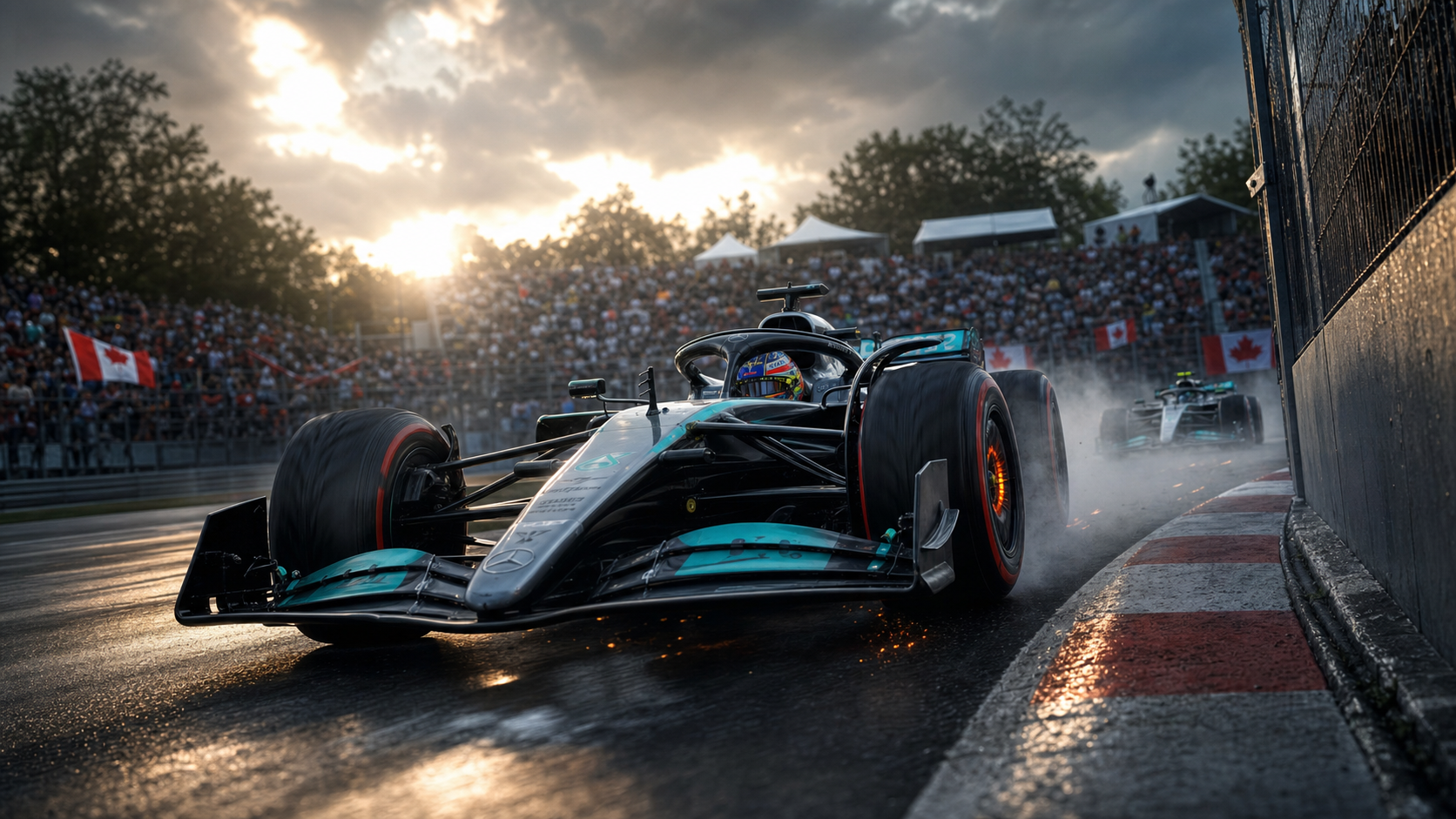

Chapter I: The Atmosphere, Paddock Rumors, and Montreal’s Concrete Crucible
The Circuit Gilles Villeneuve has always stood as one of Formula 1’s most unforgiving arenas. Nestled on the man-made Île Notre-Dame, the Montreal track is a high-speed, low-downforce labyrinth hemmed in by unforgiving concrete barriers and notorious, aggressive kerbs. It is a place steeped in racing lore—where local groundhogs routinely play Russian roulette with carbon-fiber front wings, and where the infamous “Wall of Champions” at the final chicane waitingly yawns for the slightest lapse in driver concentration.
Yet, as the paddock assembled for the 2026 edition of the Canadian Grand Prix, the usual atmospheric charm of Montreal was eclipsed by a suffocating cloud of technical anxiety and political tension. The 2026 technical regulations defined by active aerodynamics and a radical 50/50 thermal-to-electrical power unit split—had already stretched engineering departments to their absolute limits over the opening rounds. But Montreal, with its violent braking zones and long, energy-demanding straights, represented the ultimate, terrifying test of this new era.
In the hospitality suites and energy-drink stations, the whispers were deafening. All eyes were locked on the Mercedes-AMG Petronas F1 Team garage, and specifically on the side housing 19-year-old rookie sensation Andrea Kimi Antonelli. The young Italian, despite leading the World Championship after a scintillating start to his debut campaign, arrived in Quebec under immense scrutiny. Rumors swirled that senior engineers were concerned about the teenager’s emotional maturity under the strain of managing the complex new power units.
The pressure cooker boiled over during Friday’s Free Practice. Struggling to calibrate the transition between the drag-shedding “X-mode” on the straightaways and the high-downforce “Z-mode” in the corners, Antonelli suffered a highly publicized radio meltdown, screaming at his race engineer before losing the rear of his W17 and brushing the concrete wall. Critics smelled blood in the water.
Toto Wolff (Mercedes Team Principal) speaking to Sky Sports F1 in the paddock on Friday evening:
“We are operating on a razor’s edge with these power units. Kimi is pushing boundaries that even veteran drivers are struggling to comprehend. The radio outburst? That is just passion. I would rather calm down a lion than try to kick a donkey into gear. He knows the walls here don’t move, but we aren’t changing our approach.”
Chapter II: The Quirks of the Terrain and Competitor Dilemmas
Montreal’s asphalt is notorious for its low macro-texture but high micro-roughness. Because the track is rarely used outside of Grand Prix weekend, the surface begins To understand the immense challenge facing Antonelli, one must understand the unique physical and mechanical torture track layout of the Circuit Gilles Villeneuve. It is a stop-and-go circuit where tarmac volatility is a constant adversary. The track surface, rarely used outside of Grand Prix weekend, starts “green” and evolves rapidly, but its fundamental trait remains: low grip combined with immense traction demands out of slow chicanes.
The 2026 regulations turned these characteristics into an engineering nightmare. With internal combustion engines producing less raw horsepower and electrical recovery scaled up dramatically, drivers could no longer rely on brute torque to pull them out of corners. Instead, they had to harvest energy perfectly under braking without destabilizing the rear axle. Compounding this was the active aero: if the rear wing element failed to deploy from X-mode to Z-mode at the exact microsecond the driver hit the brakes, the car would suffer a catastrophic loss of downforce, leading to immediate understeer or terminal oversteer into the walls.
This reality forced a fascinating contrast in driving styles and setups. George Russell, in the sister Mercedes, opted for a more compliant, higher-downforce mechanical setup, accepting a slight deficit on the straight-line top speeds to ensure stability over the harsh Montreal kerbs. Antonelli, conversely, demanded a stiff, uncompromising platform. The Italian’s aggressive, razor-sharp style relies on an incredibly responsive front axle. He wanted to hustle the car through the apexes, trusting his lightning-fast reflexes to catch the car when the active aero transitioned.
It was a high-stakes gamble. Go too stiff, and the car would violently bounce off the kerbs, throwing the driver into the concrete. Go too soft, and the floor would bottom out on the straights, stalling the underbody aerodynamics and draining the battery before the end of the long back straight. Antonelli chose to live on the knife-edge, betting his weekend on absolute mechanical aggression.
Chapter III: From Saturday Tension to Sunday Drama
The weekend took its first major competitive twist during Saturday’s sessions. While Antonelli’s crew spent hours checking the chassis after his Friday brush with the concrete, George Russell looked serene. Russell responded perfectly to pressure from his teammate by winning the Sprint race on Saturday, narrowing the championship gap. Later in Qualifying, Russell locked in a spectacular pole position, sharing an all-Mercedes front row alongside Antonelli, sending a clear message that he was not ready to cede team leadership to his teenage counterpart.
Behind them, the fast-charging Scuderia Ferrari of Lewis Hamilton and the Red Bull of Max Verstappen locked down the second row. Despite a strong qualifying result for the team, the body language on Antonelli’s side of the Mercedes garage remained tense as engineering briefings ran late into the night.
James Vowles (Williams Team Principal) analyzing the grid configuration on Sunday morning:
To see Mercedes lock out the front row shows their current performance index, but the race today will be decided entirely by energy deployment strategy. The traction zones out of the hairpin and the final chicane are brutal, and managing the battery split under heavy tire degradation will be a tightrope walk for everyone.
Chapter IV: The Concrete Crucible Forges a Champion
Sunday brought pristine, cool conditions, but the atmosphere on the grid was electric with anticipation. When the five red lights extinguished, Russell executed a textbook launch from pole position, chopping across to hold the lead into the tight left-right apex of Turns 1 and 2. Behind him, Antonelli drove with a maturity that belied his 19 years. Rather than forcing a desperate, premature move that could risk a collision, he slotted into the leading pack, managing his tire degradation and focusing entirely on state-of-charge battery management.
For the first half of the Grand Prix, the race was a strategic chess match played at 200 mph. The front runners engaged in a high-speed convoy, utilizing the DRS and X-mode configurations to minimize drag, while conserving their hard-compound tires. Russell looked entirely in control, maintaining a steady gap over the chasing pack.
Then, on lap 31, disaster struck the leading Mercedes.
Approaching the heavy braking zone, a critical mechanical reliability issue caused Russell’s power unit to suffer an engine failure. The active aerodynamics, confused by the sudden drop in torque, left the leader helpless. Russell watched in horror on his steering wheel display as his race came to an abrupt, premature end. By the time he limped into the pit lane to retire the car, the grandstands were on their feet.
The race transformed into an immediate psychological war. Antonelli found himself leading the Canadian Grand Prix, but his mirrors were completely filled with the scarlet Ferrari of a relentless Lewis Hamilton and the matte-blue Red Bull of Max Verstappen.
What followed over the final stints will go down in Formula 1 history as a defensive masterclass. Hamilton, sensing an historic victory, threw everything at the young rookie. Utilizing the legendary late-braking capability of his Ferrari, Hamilton repeatedly pressured the Italian through the apexes.
Antonelli’s defense was cold-blooded. Time and again, he perfectly timed his transition from X-mode to Z-mode, placing his Mercedes precisely in the middle of the track, positioning his car so cleanly that Hamilton was forced into the dirty air. Behind them, Verstappen watched like a vulture, waiting for the two protagonists to collide.
Through the radio, the tension was palpable. Unlike Friday’s panic, Antonelli was a stone-cold assassin. “Leave me to it, I know what I’m doing,” was his only utterance to his engineer over the final ten laps.
As they crossed the line for the final time, Antonelli held off Hamilton by 10.768 seconds, with Verstappen just half a second further back from the Ferrari. The 19-year-old had survived the concrete crucible, taking his fourth consecutive win and answering every single critic in the most emphatic way possible.
Andrea Kimi Antonelli (Mercedes Driver) speaking to the international media pool post-race:
Friday was a disaster, and I let my emotions get the better of me. I proved today that I can handle the pressure. Holding off Lewis at a track like this… it’s the hardest thing I’ve ever done in my life. This one is for the team; they rebuilt the car, and they believed in me when people started to doubt.


