

Chapter I: A Titanic Four-Way Battle at the Circuit de la Sarthe
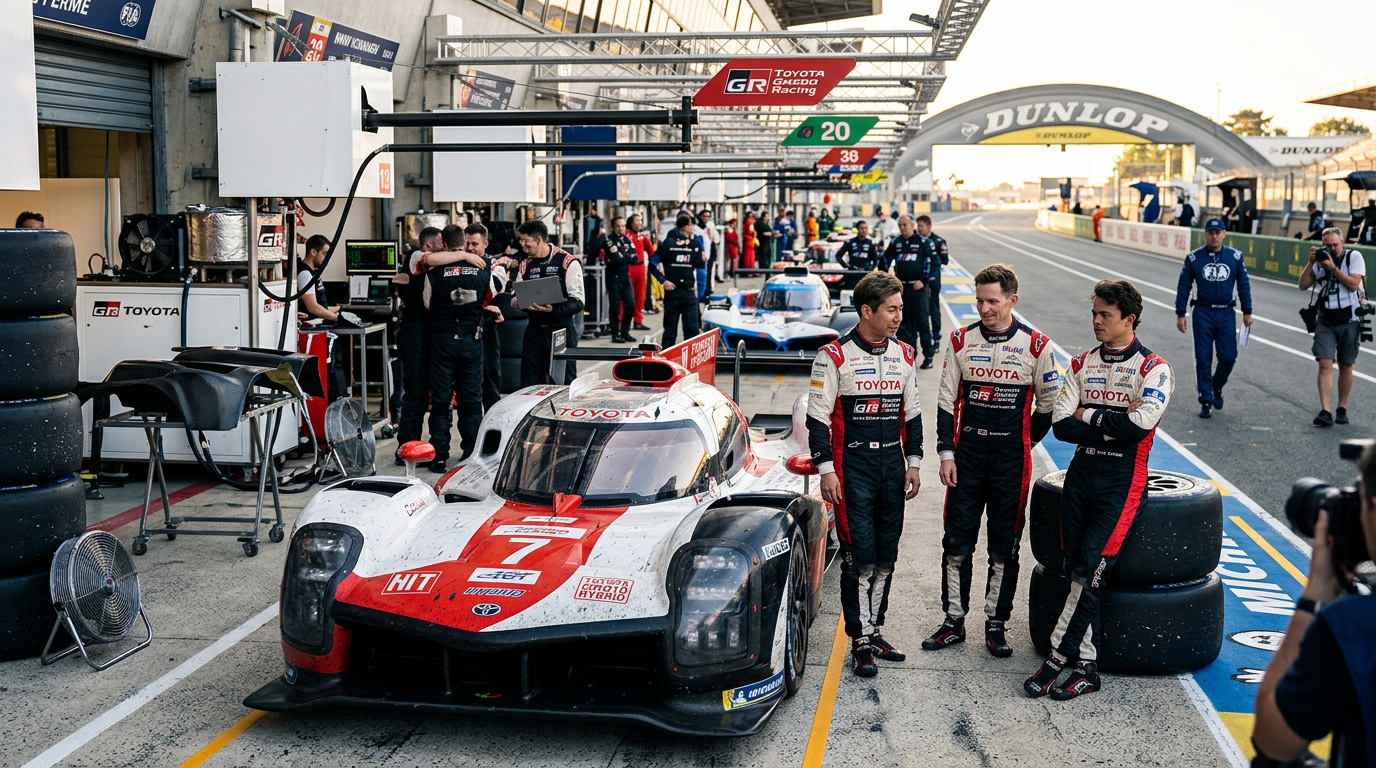
The 2026 edition of the 24 Hours of Le Mans delivered a spectacular, non-stop sprint dressed as an endurance race. At the forefront of this high-speed chess match was an intense, four-way manufacturer struggle involving Toyota, BMW, Cadillac, and Porsche. Driving under a demanding technical framework where total power output is strictly regulated to approximately 500kW (under WEC’s rigid Balance of Performance), teams had to look for advantages through tire compound degradation cycles and extreme thermodynamic efficiency. The #7 Toyota GR010 Hybrid, piloted by Kamui Kobayashi, Nyck de Vries, and Mike Conway, established itself as the car to beat, balancing raw speed with pristine traffic management through the 13.626km circuit.
Chapter II: Strategic Masterclass: Toyota’s Off-Sequence Gambit
The foundational steps for Toyota’s sixth overall Le Mans victory were taken within the opening hour of the race. Operating in highly congested traffic, the Toyota Gazoo Racing pit wall chose to roll the strategic dice. By bringing the #7 hybrid in for an early, off-sequence fuel and tire stop, they successfully placed the car into “clean air.” This maneuver allowed de Vries to execute a series of qualifying-style laps without the aerodynamic disturbance of slower LMGT3 traffic, optimizing the downforce generated by the GR010’s complex underbody venture tunnels. Furthermore, this move stabilized the car’s tire carcass temperatures, keeping them at an optimal 110C on the highly abrasive asphalt, while their rivals suffered from early thermal degradation.
Chapter III: BMW’s Relentless Pursuit and the 10.913 Second Historic Margin
Despite Toyota’s early tactical advantage, the Spa-winning #20 BMW M Team WRT crew of Robin Frijns, René Rast, and Sheldon van der Linde refused to back down. Utilizing the exceptional straight-line efficiency of the BMW M Hybrid V8, the Bavarian marque systematically hunted down the leader. As the sun rose on Sunday morning, the margin between the leading #7 Toyota and the chasing #20 BMW oscillated within a handful of seconds. The final hours were a masterclass in defensive driving by Kobayashi, who managed to fend off a late charge from René Rast. When the checkered flag waved after 381 exhausting laps, the Toyota crossed the line just +10.913s ahead of the BMW, writing a new chapter as the closest outright top-class finish in the modern history of the race.
Chapter IV: Hybrid Energy Allocation and Virtual Tank Engineering
In the 2026 WEC regulatory era, managing the “Virtual Energy Tank” is just as critical as managing physical fuel flow. The rules dictate a maximum energy allocation per stint, measured in Megajoules (MJ). Every time the 200kW front-axle MGU deploys energy or recovers it under braking, the electronic control unit (ECU) logs the energy balance. The Toyota engineering team utilized highly advanced predictive software mapping, which adjusted the hybrid assist on the exits of the Mulsanne chicanes depending on real-time slip angles. By limiting unnecessary front-axle spin, Toyota preserved roughly 0.5 MJ of energy per lap compared to the stiffer BMW, allowing them to extend their final fuel stints by one critical lap and securing the crucial track position that defined the final outcome of the race.


