

Chapter I: Thermal Engineering and Damper Resilience in Extreme Heat
The Greek summer of 2026 pushed atmospheric conditions to absolute extremes, with ambient levels soaring past 40C and ground temperatures on the exposed gravel stages of Central Greece easily exceeding 55C. In the Rally1 category, managing extreme heat is not limited to engine and transmission cooling; it is a critical struggle to keep the hydraulic fluid inside the suspension dampers from boiling. Under the relentless pounding of the rough Acropolis bedrock, damper internal temperatures can breach 150C. At these limits, the hydraulic oil loses its viscosity, leading to aeration (foaming) and a sudden loss of damping efficiency known as “damper fade.”
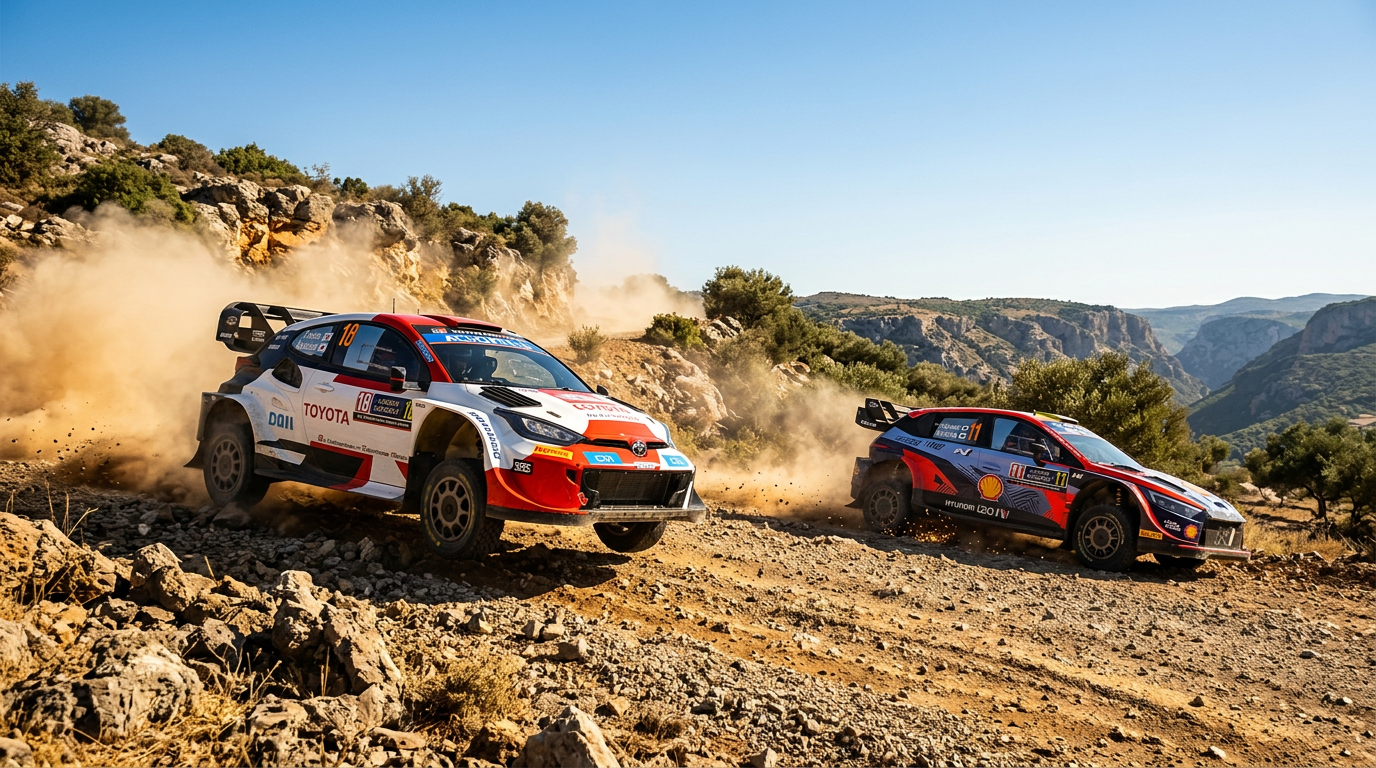
Toyota’s engineering department at their Jyväskylä headquarters proved to have the technical upper hand. The GR Yaris Rally1 utilized specialized, high-capacity Reiger suspension systems fitted with proprietary external cooling fins and high-viscosity-index synthetic fluids. This structural choice allowed the Toyota drivers to maintain consistent ride-height and chassis control throughout the longest, most punishing loops. While the Hyundai i20 N setups struggled with high-speed stability as their dampers softened in the midday heat, the Toyotas floated over the ruts, keeping their underbody skid plates from damaging critical hybrid battery enclosures.
Chapter II: Hankook Dynapro R213 Tyre Preservation and Rim Dynamics
Beyond thermal management, the sharp, volcanic schist of the Peloponnese presented a constant threat of puncture to the hard-compound Hankook Dynapro R213 tyres. On these punishing surfaces, tyre preservation relies heavily on suspension kinematics and steering geometry. If a car’s track or camber changes too aggressively under full compression, the tyre’s sidewall is exposed directly to jagged rocks, resulting in instantaneous slicing.
Toyota’s chassis setup minimized lateral load spikes by running a highly progressive spring-rate configuration combined with slightly softer anti-roll bars. This allowed the tyre contact patch to remain flat relative to the road surface, distributing the energy of vertical impacts across the tread blocks rather than letting them pinch against the rim. Consequently, while Hyundai drivers were plagued by sidewall cuts and structural rim deformation, the Toyota drivers extracted maximum longevity from their Hankooks. They managed their slip angles efficiently, keeping tyre tread surface temperatures within their optimal operating window of 90-110C completely bypassing the catastrophic blistering that cost their rivals vital minutes.
Chapter III: Katsuta’s Mature Drive and the TGR Clean Sweep
Transforming this technical reliability into a dominant sporting result required immense discipline behind the wheel, a trait exemplified by Takamoto Katsuta. The Japanese driver delivered a masterclass in risk management, purposely backing off in high-risk zones. By deliberately avoiding the inside edges of blind corners where hidden boulders threatened to break steering arms, Katsuta maintained a clean, steady line. While this calculated approach cost him fractionally in raw speed, it insulated him from the tyre and mechanical dramas that decimated the rest of the field.
Following the post-race safety penalties handed down to McErlean and Fourmaux, Katsuta’s mature approach was rewarded with a stellar 3rd place finish on the podium. Backed by Sami Pajari’s elevation to 4th and Elfyn Evans’ promotion to 5th, Toyota Gazoo Racing achieved a crushing technical statement, occupying four of the top five final positions and showcasing unmatched mechanical bulletproofing in the most hostile environment on the WRC calendar.
Chapter IV: The 140-Point Chasm and the Baltic High-Speed Horizon
This overwhelming team triumph has dealt a devastating blow to the manufacturers’ championship standings. Toyota Gazoo Racing has extended its massive lead over Hyundai Shell Mobis WRT to a staggering 140 points, with the tally now standing at 416 to 276. This points gap leaves the Alzenau-based Hyundai squad under immense psychological and technical pressure as the championship moves away from slow, rough, and hot rock crawls to the polar opposite: the ultra-fast, smooth, and high-flying gravel highways of Estonia and Finland.
On these Baltic high-speed stages, raw mechanical endurance is replaced by aerodynamic efficiency, damper high-speed rebound control over massive jumps, and high-speed stability. Hyundai’s engineering department must rapidly redesign their aerodynamic mapping and suspension blow-off valves to match Toyota’s high-speed aero package, knowing that another structural misstep on fast gravel will put the manufacturers’ title mathematically out of reach before the season’s flyaway events.


